Is 50 Too Young for a Deep Plane Facelift?
Stephanie’s Artiste Lift™ Case Review
When Stephanie first met with Dr. Richard Balikian about the changes she was seeing in her lower face and neck, he did not recommend surgery. He told her to come back in a few years.
She did.
By then, Stephanie had just turned 50. She was seeing more looseness and sagging through her lower face and neck. Dr. Balikian saw early jowls, a neck that was beginning to sag, a jawline that was losing definition, and volume loss around the lower face.
“I had just turned 50 and noticed some looseness and sagging in the lower face and neck area. I chose Dr. Balikian because he had done a similar procedure on a friend of mine a few years ago. She was extremely happy.”
– Stephanie
Stephanie knew what was bothering her. Dr. Balikian could now see an anatomical reason to treat it. Her Artiste Lift™ was built from those two perspectives.
Stephanie originally chose Dr. Balikian because he had performed a similar procedure for a friend. Her friend was extremely happy, so Stephanie came in to discuss the changes she was beginning to notice in herself.
That first consultation did not lead to an operation. Dr. Balikian felt it was too early and told her to come back in a few years. For Stephanie, that recommendation became part of the reason she trusted him. When she returned, she knew he was not going to suggest surgery simply because she had asked about it.
At both consultations, Stephanie felt that Dr. Balikian listened carefully to what was bothering her. When she returned, he recommended a procedure tailored to those concerns without encouraging her to add anything she did not need.
“I didn’t feel like he was trying to upsell me or push me into procedures that I didn’t need. I know I didn’t need to do this. It was something I wanted to do to feel better.”
– Stephanie
That conversation made her feel confident going into surgery.
One of the biggest misconceptions about facial plastic surgery is that surgeons spend their days convincing patients to have procedures. In reality, I spend a surprising amount of time doing the opposite. I say no to patients all the time.
When Stephanie first came to see me, I did not believe a facelift would create enough meaningful improvement to justify surgery. The responsible recommendation was to wait, so I told her to come back in a few years.
When she returned, I was not recommending surgery simply because she was older. Her anatomy had changed. She was developing early jowls, her neck was beginning to sag, her jawline was losing definition, and there was now something specific I could improve while preserving the youthful face she still had.

Stephanie shares why she chose to have an Artiste Lift™ at 50, what gave her confidence in Dr. Balikian and her experience with recovery.
Stephanie described the change as looseness and sagging in her lower face and neck. Dr. Balikian saw the anatomy behind it.
She was beginning to develop jowls. Her neck was starting to sag, and the border of the jaw was becoming less sharp. She also had volume loss through the marionette lines, nasolabial folds, and pre-jowl region. None of those changes was advanced. Stephanie still had a youthful face. The problem was that the youthful structure was becoming harder to see.
As Dr. Balikian explained in his review, her face was being “clouded by all this gravitational change.” That distinction shaped the entire operation. This was not a case that called for a dramatic transformation. It called for a precise correction of the changes that were beginning to interrupt her jawline, soften her neck, and deepen the shadows around her lower face.
Dr. Balikian explains that surgeons once tended to wait until patients reached their mid-50s or later before considering a facelift. With older SMAS facelift techniques, visible signs of surgery could be harder to justify in someone who was younger and still had many youthful features.
The preservation deep plane approach changed that calculation. Rather than depending on skin tension to create the lift, the operation repositions the deeper facial tissues. This allows Dr. Balikian to address early structural aging while aiming to preserve the character of the face and avoid an obviously operated appearance.
Stephanie was not a candidate simply because she had turned 50. In fact, Dr. Balikian had already told her to wait once. She became a candidate when the changes in her anatomy had progressed enough for surgery to create a meaningful improvement.
Stephanie underwent Dr. Balikian’s comprehensive Artiste Lift™, including a Preservation Deep Plane Facelift, Deep Vertical Neck Lift, Temporal Lift, and Partial Face Fat Transfer.
Each part of the operation had a specific purpose.
Stephanie’s early jowling was not simply loose skin. The deeper tissues of her cheek had begun to descend, creating fullness along the jawline and a shadow where the cheek transitioned into the marionette and pre-jowl regions.
During the Preservation Deep Plane Facelift, Dr. Balikian released the retaining ligaments that were holding those descended tissues in place. This allowed him to reposition the deeper facial layer in a more vertical direction, softening the jowls and restoring a smoother line from the cheek into the jaw.
The goal was not to stretch Stephanie’s skin or pull her face sideways. Once the deeper tissues were returned to a more youthful position, the skin could follow naturally without carrying the tension of the lift. This improved her jawline while preserving the movement, proportions and recognizable character of her face.
Stephanie’s neck could not be fully corrected by treating skin or superficial fat alone. Dr. Balikian identified deeper structures contributing to the softened angle beneath her chin.
During the Deep Vertical Neck Lift, he conservatively reduced portions of the submandibular glands and digastric muscles. He also performed a hyoid fasciotomy, releasing tissue that restricted the neck angle.
That deeper work allowed the neck angle to rise and made a significant difference in the definition of her neckline and jawline.
When Dr. Balikian elevated Stephanie’s lower face in a vertical direction, the skin moved upward with the deeper tissues. That movement created excess skin near the temple. If it were not addressed, the skin could bunch in that area and interrupt the smooth transition created by the facelift.
The Temporal Lift allowed Dr. Balikian to redistribute and remove that excess skin rather than leaving it gathered at the top of the lower-face lift. This was not added because Stephanie needed a separate or dramatic brow lift. It was performed as a complementary part of her Artiste Lift™ so the skin could lie smoothly from the temple through the cheek and into the newly defined jawline.
Lifting corrected tissue descent, but it did not replace lost volume. Dr. Balikian added small amounts of fat to Stephanie’s marionette lines and pre-jowl area to soften the remaining shadows.
The fat was not used to make her face larger or fuller. In Dr. Balikian’s words, it was “sprinkled in the right places.” Together, the facelift, neck lift, temporal lift, and selective fat transfer formed Stephanie’s Artiste Lift™. It was not a standard package. It was the combination her face required.

Dr. Balikian explains the early facial and neck aging he identified and how Stephanie’s customized Artiste Lift™ restored jawline and neck definition.
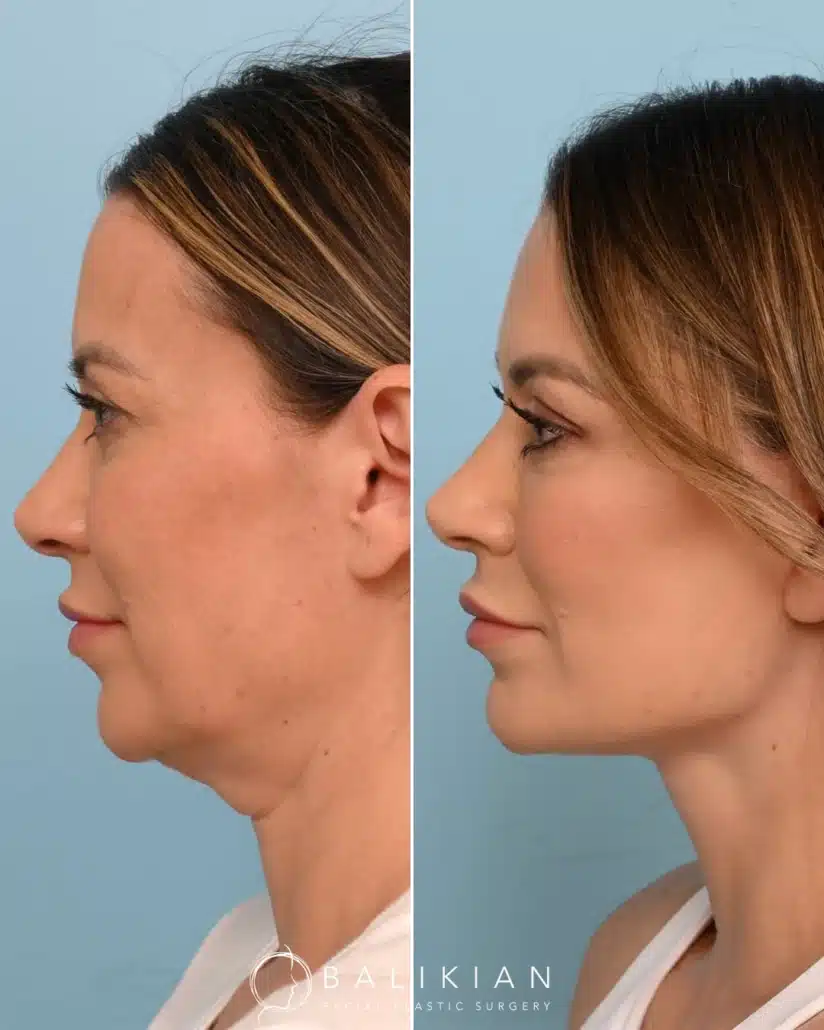
The strongest change appears in Stephanie’s profile. Before surgery, the transition beneath her chin was softer and the mandibular border was less distinct. After surgery, the neck angle is sharper, the jawline is easier to see, and the transition from the lower face into the neck is cleaner.
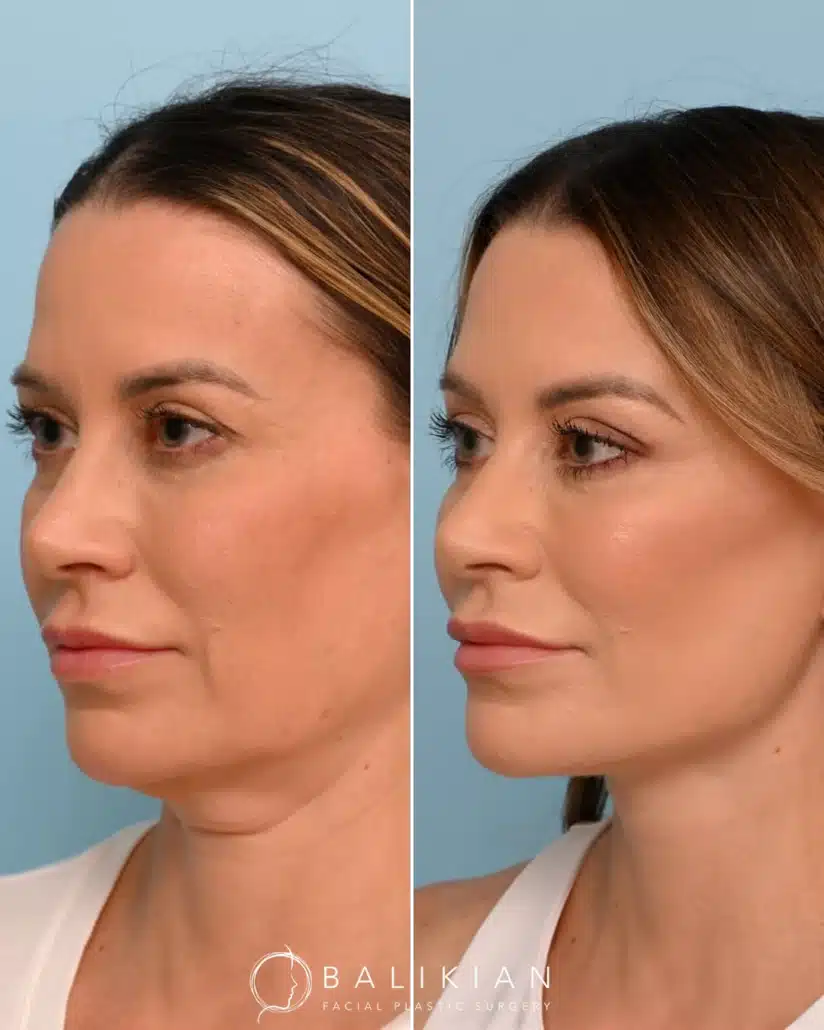
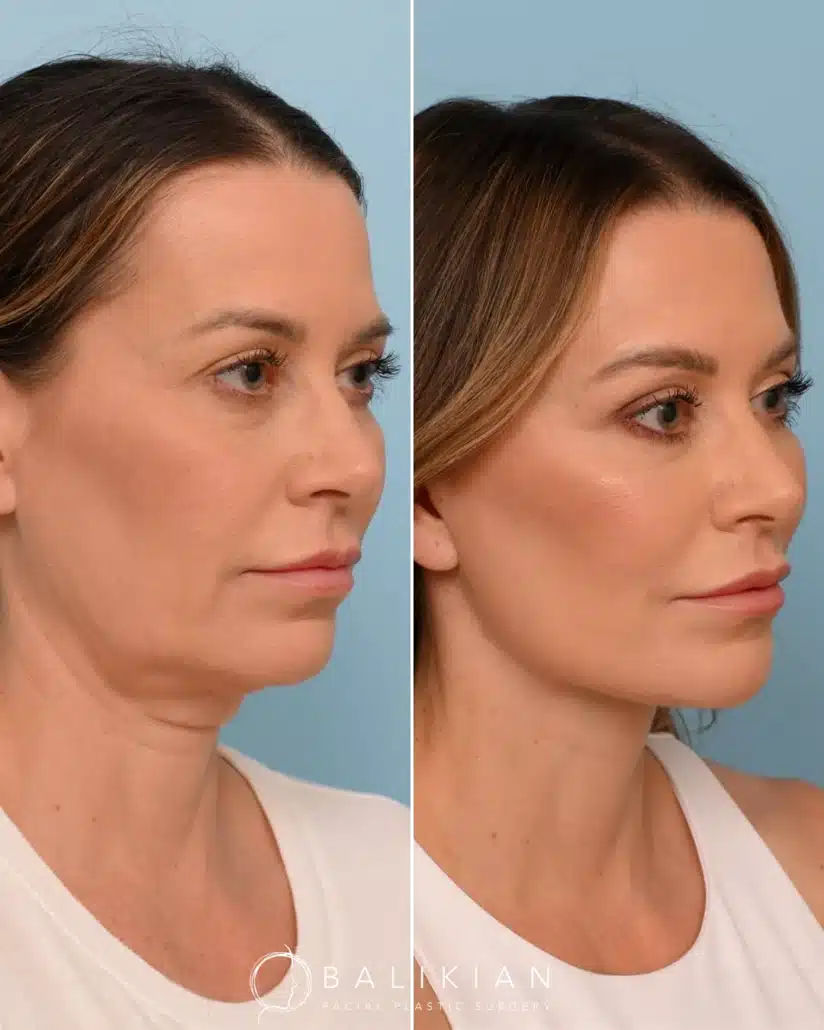
The three-quarter views show the change through the jowls and pre-jowl area. The lower face no longer looks interrupted where the tissues had begun to descend, and the transition into the marionette region is smoother.
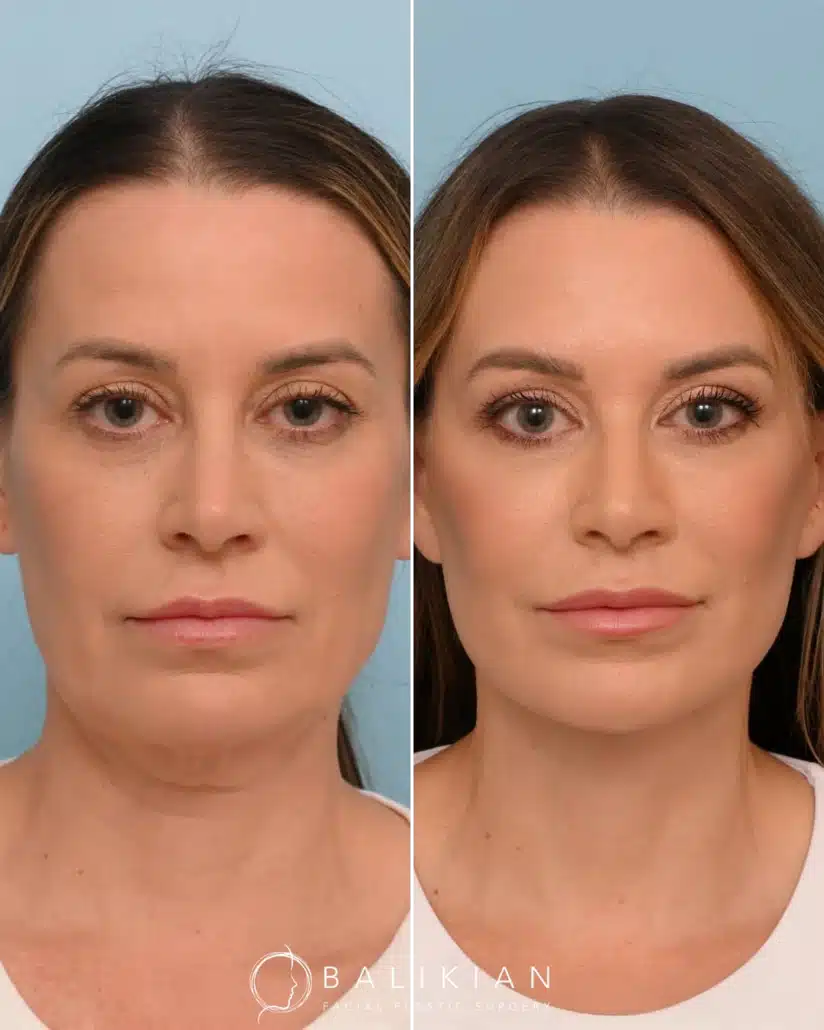
The frontal view shows the restraint of the result. Stephanie remains recognizably herself. Her youthful features were not replaced or exaggerated. The changes that had begun to cloud them were softened.
Dr. Balikian describes the result as bringing Stephanie “back to the way she felt before.” Stephanie puts it more simply: she is happy with her result.
Stephanie’s photographs show her result from the front, both profiles, and both three-quarter views.
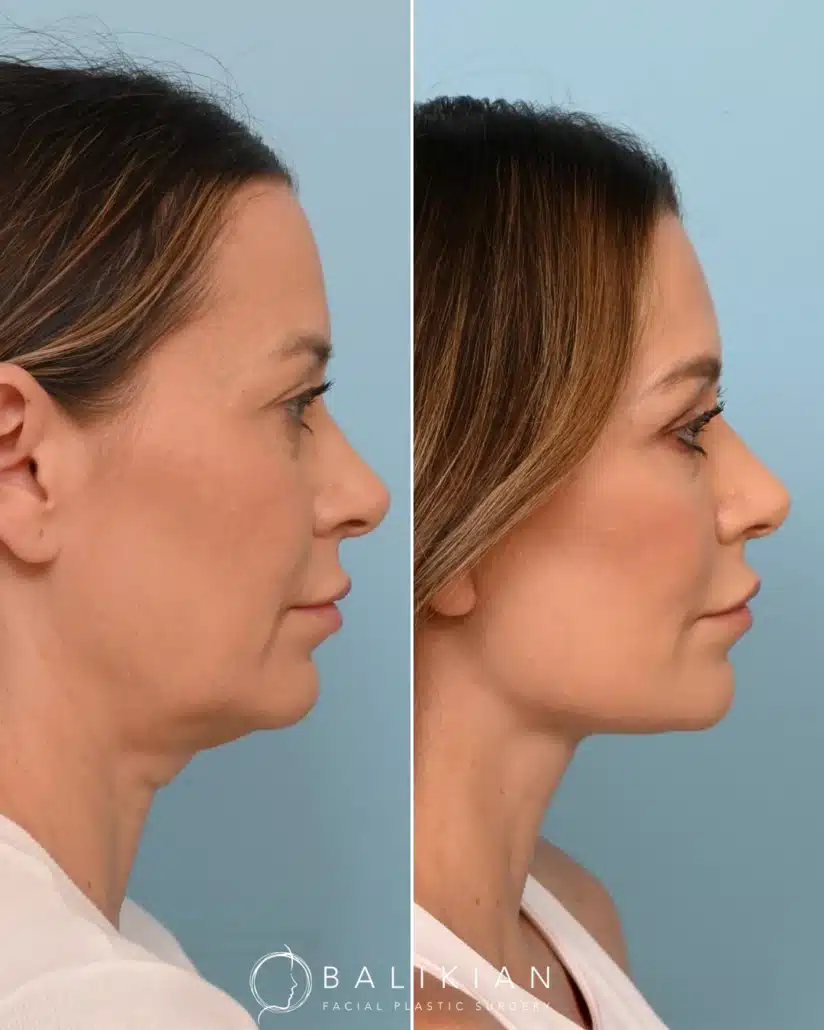
Results disclaimer: Individual results vary. Before and after photographs depict this patient’s outcome and do not guarantee a similar result for another patient.
Stephanie went into surgery feeling confident, but she admits she underestimated recovery. As a business owner, downtime was one of her biggest concerns. She hoped to be back at work within a week.
The second and third days were the most difficult. Around day five, she reached what she called a mental “pothole.” Dr. Balikian had prepared her for that stage, and it happened almost exactly as he had described.
Stephanie followed her postoperative instructions, including icing, taking her vitamins, attending follow-up visits, and receiving light-based treatments. She felt that her swelling and bruising improved each day. By day 12, she said the bruising was hardly there, and she was back at work.
“I underestimated the recovery process. I think the second and third day was the worst. By day five, I sort of hit a mental pothole, which was to be expected. Dr. Balikian told me that would happen, and it did almost exactly as he said.”
– Stephanie
Stephanie’s recovery reflects her individual experience. Recovery varies according to the patient, the procedures performed, and how the tissues heal.
Stephanie’s case began with Dr. Balikian telling her to wait. When she returned a few years later, the recommendation changed because the anatomy of her face and neck had changed.
Stephanie could identify the looseness and sagging that now bothered her. Dr. Balikian could see the early jowling, loss of jawline definition, neck laxity and volume loss responsible for those changes. There was now something he could meaningfully improve while preserving the youthful qualities she still had.
“Everyone is different. Age is just a number. I have seen patients in their 40s with weaker, less healthy tissues than patients who are much older. What matters is not reaching a certain birthday. It is how aging has affected the tissues underneath and whether there are changes we can meaningfully improve.”
– Dr. Balikian
For Stephanie, turning 50 did not automatically make it the right time for a facelift. It was the point when what she was seeing and what Dr. Balikian was seeing anatomically came together.
Her Artiste Lift™ addressed those changes without taking away what both of them wanted to preserve: a face that was still youthful, natural,and unmistakably hers.
Is 50 too young for a deep plane facelift?
There is no single age that determines facelift candidacy. Dr. Balikian told Stephanie it was too early when she first consulted with him. When she returned a few years later, the jowling, neck sag, jawline blunting, and volume loss had progressed enough for him to recommend surgery.
Research evaluating long-term facelift results has reported positive satisfaction among younger patients treated for early or minimal facial aging.
Why were Stephanie’s facelift and neck lift performed together?
Stephanie’s jowls, jawline, and neck were part of the same pattern of aging. Treating only the face would have left the softened neck angle unresolved. Treating only the neck would not have repositioned the tissues creating the jowls. Combining the procedures created a continuous correction from the lower face through the neck.
Why did Stephanie’s neck require more than liposuction?
The contour of Stephanie’s neck was influenced by deeper structures, including the submandibular glands and digastric muscles. Liposuction can reduce accessible fat, but it cannot address every structure that contributes to a softened neck angle.
Why was fat transfer included?
Dr. Balikian identified volume loss in addition to tissue descent. After lifting the deeper facial tissues, he used small amounts of fat to soften Stephanie’s marionette and pre-jowl regions. The fat transfer addressed shadows that lifting alone would not completely correct.
How did the deep plane facelift improve Stephanie’s jowls?
Jowls develop as facial tissues descend across the mandibular border. During Stephanie’s Preservation Deep Plane Facelift, Dr. Balikian repositioned the deeper facial layer rather than depending primarily on tension placed on the skin. This softened the jowls and restored a smoother transition from the lower cheek into the jawline.
Published descriptions of deep plane facelift surgery identify improvement of the jowls, mandibular contour, neck, and nasolabial region as primary objectives of the technique.
What role did the hyoid fasciotomy play in Stephanie’s neck lift?
The hyoid region helps form and support the angle where the underside of the chin meets the neck. In Stephanie’s case, Dr. Balikian performed a hyoid fasciotomy to release restriction in this area and allow the neck angle to rise. This contributed to the sharper transition beneath her chin and improved definition of her neckline and jawline.
Anatomical research has identified a suspensory structure connecting the platysma and skin to deeper tissues near the hyoid bone, supporting the role of this region in maintaining the cervicomental angle. Surgical techniques involving hyoid-region support have also been studied for improving neck definition, although the specific techniques vary.
Why was a Temporal Lift included when Stephanie’s main concerns involved her lower face and neck?
When Dr. Balikian elevates the lower face during a deep plane facelift, the upward movement can create excess skin that bunches in the temple area. He performs the Temporal Lift to address that skin and create a smooth, continuous transition instead of allowing the lift to stop abruptly near the temples.
This is a recognized surgical issue: vertical elevation of the cheek can create significant excess skin at the temporal level.
How did Dr. Balikian preserve Stephanie’s facial identity?
Stephanie still had a youthful face before surgery. Dr. Balikian’s goal was to uncover that existing structure, not replace it with a different appearance. He repositioned descended tissues, refined the deeper neck, and replaced volume only where it had been lost. The frontal after photograph shows that Stephanie’s proportions, expressions, and recognizable facial character were preserved.
Dr. Richard Balikian is a highly respected facial plastic surgeon serving the San Diego area.
With over 20 years of experience and double board certification in Facial Plastic and Reconstructive Surgery as well as Head and Neck Surgery, Dr. Balikian offers a unique combination of technical expertise and artistic vision.
He is part of an elite group of surgeons with extensive training focused exclusively on the face and neck.